
I’m not sure we can call boardgaming a niche hobby anymore due to the explosive growth of crowdfunded board games. And that has big ramifications for how we play and talk about games.
Many years have passed since Settlers of Catan fired its first broadsides at Monopoly. As I write this Spirit Fire, a new game published by Orange Nebula, has 10 days left in its crowdfunding campaign. The first description you see on the campaign page reads:
Wisdom is your only weapon.
Spirit FireTM is a non-linear, open-world board game system in which you explore unique fantasy realms on an introspective journey of discovery, wonder, and mystery. Your choices matter because you’re not following a story – you ARE the story.
There is no combat in Spirit Fire. It’s time to wield something more powerful than a sword: your mind, your heart, and your spirit.
Over 4,600 backers have pledged over $600,000 to Orange Nebula in order to get their introspective, wise, and wondrous hands on this game. In 1995 (when Settlers of Catan was first released), it would have been unimaginable that a game such as Spirit Fire could even exist much less be trending towards over $1 million in funding.
Crowdfunding = Innovation
This post is not going to be entirely about crowdfunding, I promise, but the sustained explosive growth in crowdfunding dollars toward board games is a good place to start.
You could read the above about Spirit Fire and think that I am mocking it. A little, but not entirely. Even though I concluded the game is not for me (several explanatory videos that left me with more questions than explanations will do that), it’s wonderful that Orange Nebula team can pursue its creative ambitions to push the boundaries of boardgaming. And clearly they are onto something since so many people jump on board with them.
In researching this post I came across a journal article on crowdfunding and innovation, looking specifically at the board game industry. They use some sophisticated mathematics to prove that crowdfunding is having a positive effect on innovation. The paper tracks whether crowdfunded games use novel combinations of gameplay mechanisms (route building + push your luck + deckbuilding, etc.) and whether those games and their combinations of mechanics serve as “nodes” for future crowdfunding campaigns to emulate.
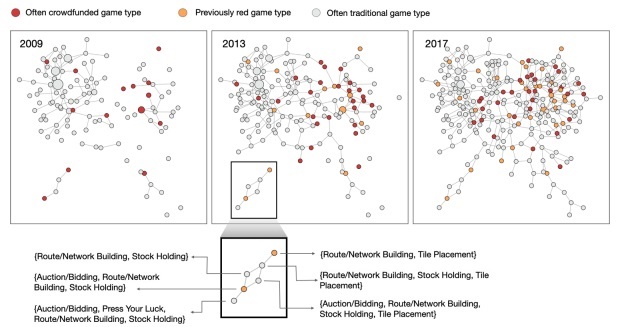
Orange Nebula probably agrees that crowdfunding supports innovation. Crowdfunding gives them a platform to pitch their game to a world of geeks rather than a roomful of stodgy executives. Although after watching a few videos I still cannot honestly tell you how the game is actually played, I’m confident they are trying to break new ground or at least tread in the freshly broken ground of some other crowdfunded game. A red dot.
The Downside of Growth
It turns out that innovation is big business. Would you just look at this bar chart from Polygon? Enough nodal analysis, show me nice big solid bars! It doesn’t even include the $40-50 million from Gamefound and Backerkit in 2022!
!function(e,n,i,s){var d=”InfogramEmbeds”;var o=e.getElementsByTagName(n)[0];if(window[d]&&window[d].initialized)window[d].process&&window[d].process();else if(!e.getElementById(i)){var r=e.createElement(n);r.async=1,r.id=i,r.src=s,o.parentNode.insertBefore(r,o)}}(document,”script”,”infogram-async”,”https://e.infogram.com/js/dist/embed-loader-min.js”);Another graph has slightly different numbers, but shows the same upward trajectory: somewhere between 300% and 600% growth from 2013 to 2022.
I don’t have any issue with the plucky Orange Nebulas of the world making their money and paying their people, but when Steamforged Games churns out another undertested and overproduced IP-themed game and makes millions, I have to call bullshit on the innovation theory of crowdfunding. The glorious upstarts are being dwarfed by the sundropped plastic pushers (with a veneer of original thought and game design).
As much as crowdfunding is a way to make your earnest and heartfelt plea for geeks of the world to unite, it’s also a way to bedazzle consumers with graphics, promises, and stretch goals. The campaign countdown, exclusives, and discounted prices form a psychological cocktail that could stupefy even the most stalwart hero. There’s also an ecological effect on production and waste that we shouldn’t ignore since most of these games are made out of plastic and shipped from China.
Nasty, evil, tricksy exploding growth
I don’t expect you to disagree very much with any of what I’ve written. Innovation, accessibility, with some not-insignificant downsides. So where’s the hot take? What are you really driving at?
I believe that the massive growth of the hobby has changed in subtle, pervasive, and inescapable ways how we discover, play, and think about games. I can’t really prove this, it’s more of a feeling that developed over the past few years. Sorry, I have no fancy embedded bar chart for you.
Replayable in theory
Examining one of the biggest buzzwords will help illuminate my point. There are several ways to define replayability, but the most common way I see it used is to gauge how much variation the game offers so that you will never have to play the same game twice. Essentially, newness staves off boredom. The more a game offers, the less likely I will get bored with it. What bothers me is the not-so-subtle evaluation of games with the assumption that the more stuff a game offers, the longer and more likely I will be happy with it. If that isn’t the convergence of materialistic capitalism with boardgaming, I don’t know what is.
Two of the oldest games in the world are backgammon and chess. I’m decent-to-good at backgammon and decent-to-bad at Chess. Chess is a lot like pool. You can pretend you’re really good by lining up your shot by stroking your chin and striding around the table, but once you hit the ball it’s pretty clear whether you actually know what you’re doing. Anyway, backgammon and chess don’t have variable set-ups, variable player powers, variable win conditions, or a branching campaign narrative. Yet they have been replayed many more times than Gloomhaven ever will be. Why? Efficient design, simple rules, and emergent complexity through unpredictability (from dice or your opponent). Not a whiff of sundropped minis or 500 event cards.
I can almost guarantee you that the majority of the people banging out a forums question asking about the replayability of a game are not going to replay it very many times. They are going to keep buying new and different games because that is what the materialistic mindset demands.
How much do I love thee? Let me count the clicks
Another way the growth of our hobby has infiltrated how we engage with games is in how games are reviewed and discussed. A lot of people start YouTube channels chasing the opportunity to get review or preview copies of games, gain sponsorships, and earn ad revenue. The profit motive muddies their motives. Are they reviewing a game because it’s really that good or that bad, or is it because high praise or stunning critique generates clicks? Is it actually good or do they want to maintain a good relationship with that publisher? The explosion of reviews is driven by the Kickstarter/Gamefound/Backerkit funding explosion. The purpose of many reviews and previews is to help you spend your money, not introduce you to a beloved game, gamer to gamer.
One of my most favorite BGG events is the People’s Choice Top 200 solo games hosted in the 1 player guild. There is such a tantalizing build up during the month of voting. As games are posted players gush and rave about their favorites, even if it is 187 out of 200. These casual reviews are so much more inspiring and informative than a perfectly edited and produced 20 minute video. (Let me caveat at this point that there are some YouTube channels that I respect a great deal and seek out).
Holding onto the Fun
We play games to have fun and be happy. Happiness through acquisition of new things and experiences is a pretty thin form of happiness, because, by definition, the new thing becomes familiar and you have to keep seeking the next thing. Instead, what would it be like to play our games contentedly? To hold our enjoyment loosely, rather than to try to squeeze out every drop?
This blog is dedicated to this practice of enjoying the games you have rather than chasing the ones you don’t. I’m guilty of my fair share of late night BGG trade machine browsing, impulse backing, and driving much longer than I should to check out the used game sections of different game stores. But when I look at my game shelf and pass over those new titles that burned a hole right through my pocket and reach for the game that I can’t stop thinking about because it’s so good, I like to think that’s an important act of defiance of all the industry forces that would rather I feel jaded and unsatisfied with my current options.
I want to end with the sage words of Jacob, a BGG user who last logged in 2 years ago but 16 years ago wrote a glowing review of Settlers of Catan. He uses the phrase “replay value” but somehow I think he’s probably ground his copy of Catan into cardboard dust. We could all feel inspired by his unabashed joy about his GOAT game.
Hands down the best game ever. The perfect blend of strategy and luck. The perfect length (an hour or less once everyone understands the rules). Zero down-time. Almost zero analysis-paralysis. The most replay value I have ever seen in a game. Stupendous, superb, and practically flawless. There are not enough superlatives in the English language to describe this game. I wish there were more games that I could describe in the same glowing terms! Settlers of Catan is the Greatest Of All Time (the GOAT, baby!).
If you do not own this game, shame on you. It really is the best way to convert new people to our beloved hobby and more people participating in our hobby will only mean more great games for us!
 Go Wild Board Games
Leave a comment