
My deck construction series works through the starting cards in each Specialty and Background. I don’t want these to get too complex and lengthy, but at the bottom I do offer some deck combinations for you to look over for ideas and inspiration. I may expand these posts in time to include more discussion of the different possible combinations.
Deck Construction Series
-
Artisan Deck Construction in EBR
-
Shepherd Deck Construction in EBR
-
Forager Deck Construction in EBR
-
Traveler Deck Construction in EBR
-
Explorer Deck Construction in EBR
What makes a Forager unique?
The Forager background revolves around the flora trait. You can add it to features or beings and scry the path deck and discard for flora cards. Once you have a flora in play, you can use it in many ways to dodge cards, clear Trails, soothe fatigue, or gain energy.
The background offers a strong base for your deck through its soothing and energy generating possibilities, as well as the flexible ways you can use Flora to your advantage. Forager really shines when paired with certain Specialties or particular cards through your outside interest or deck progression that expand the functionality of those Flora-based effects.
A relevant note for Forager is that you can place harm on cards without a harm threshold but those cards will never clear. This can actually work in your favor if you have a Flora feature that clears through a Ranger token because you have an inexhaustible fuel source for your Flora engine!
Cards by Sphere
Awareness
Awareness is the special focus of the Forager. It has three card choices as well as the Expert card of the Background.
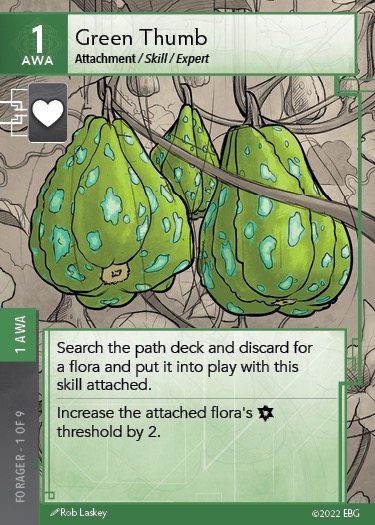
Green Thumb is a very useful card and essential to any Forager deck. It is the Expert card, so take it at the beginning or lose out forever.
Searching the path deck for a Flora allows you to start triggering your other Flora-based effects. Also, if you’re looking for a particular being or feature, this card will shrink the Path deck, increasing the chances you’ll draw what you’re looking for.
Increasing the threshold allows you to do more Forager-ery things before that card clears.
Consider bringing in Mother of Invention through deck progression so you can get more uses out of Green Thumb.
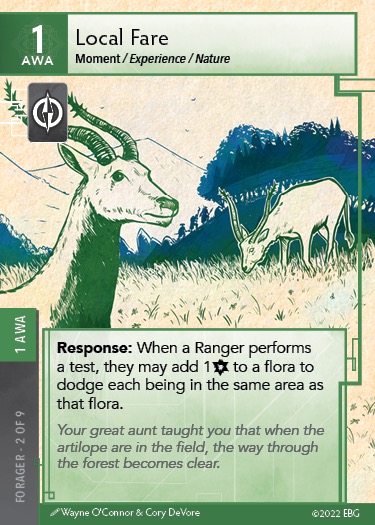
Local Fare is one of the situational Forager cards, but it can be nice in a pinch to avoid fatigue. If you’re Within Reach area has a couple beings in it, you can dodge them all to interact with something further away.
You have to be careful to not overly rely on dodging cards versus clearing or avoiding them, because their challenge effects will still trigger. Dodging only allows you to avoid fatigue when interacting beyond them.
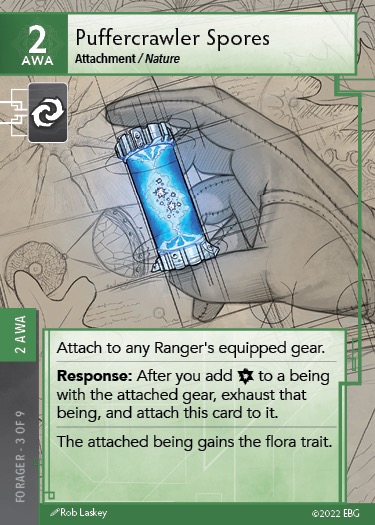
Puffercrawler Spores is a neat card that requires some setup before it starts to shine. First you need to play it and a gear that places harm, most likely a Weapon, then you need harm a being with that Weapon, then you transfer this card to make it a Flora.
If you accomplish all that, you can trigger your Flora effects off that being (which also adds harm to the being to eventually clear it). A lot of steps, but still a novel way to clear beings without tests (if you use the various Moments in Forager) and gain additional benefit along the way.
As with Green Thumb, consider including Mother of Invention to get more uses out of this attachment.
Fitness
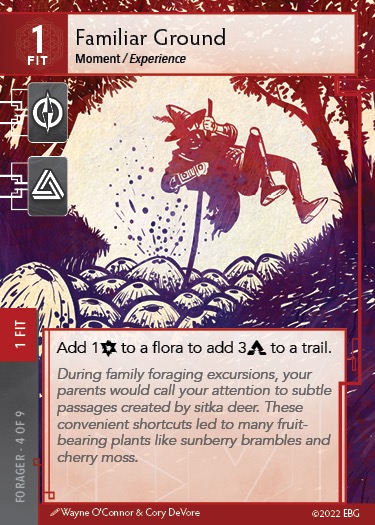
Familiar Ground is a useful card to capitalize on Flora cards. Trail Markers (from Artificer) expands the utility by making any feature a Trail. I have very little to say about it since it’s such a straightforward and beneficial card.
This is also an excellent card in that it only requires 1 FIT but is very beneficial for a low FIT build.
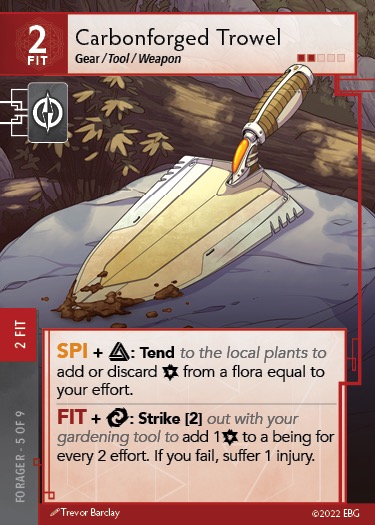
Carbonforged Trowel is the weapon of the background, but a unique one at that. It is the only weapon that allows you to place harm on both features and beings. Additionally, it’s one of the only cards that allows you to heal another card in the game (through its SPI test).
As a weapon for dealing damage to beings it is on-par with the EBR standard of 1 harm per 2 effort with an injury as a consequence for failure. Not very efficient. To fully benefit from this card you will want at least a 2 in your SPI aspect and include Puffercrawler Spores in your deck. You’ll be able to deal damage much more efficiently to beings without the consequence of an injury.
The equip cost is a bit high considering its just a handheld shovel, but it has to stay on par with the equip cost of other weapons.
Focus
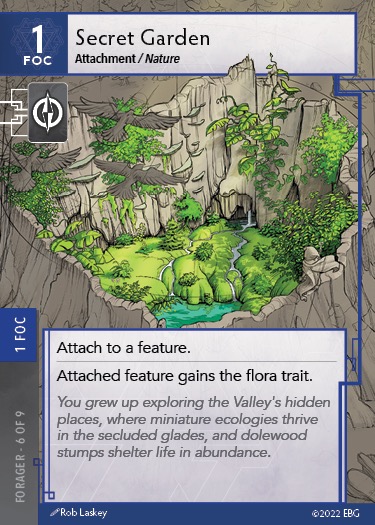
You would take Secret Garden to give yourself another way to start building your Flora engine, but I prefer Green Thumb which accomplishes the same thing and lets you find a feature you want. You may want to start with Secret Garden in your deck then pare down to 1 or no copies of it depending on how many Flora you like to have in play. Keep in mind it is an Attachment so you cannot add it after deck construction.
A potential good use for this is to add Flora to an innocuous feature that clears with a Ranger token, which means you can place an infinite amount of harm on it without ever clearing it.
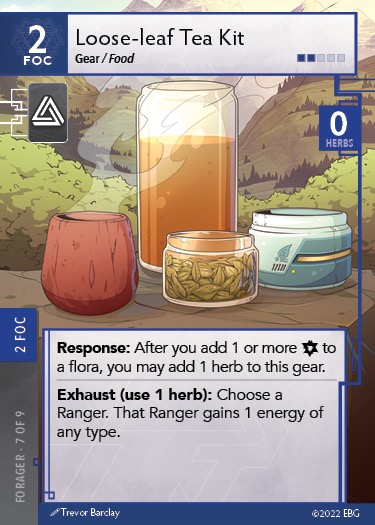
Loose-leaf Tea Kit is an important layer for your Flora engine because it captures all the tending you do as energy for future use. You can only use 1 energy per turn since it exhausts, but used correctly it can be a battery that sustains you throughout the day. If you deal more than one harm at a time, however, you only get to add 1 Herb to this card.
It’s equip cost is significant. Between it and the Trowel I might be seeing the Pocketed Belt Pouch in your future…
Although this card is good, it does require you to take 2 FOC in your aspect so you need to have a plan for how to use that energy every turn. Perhaps acquiring a Field Journal would be a good idea.
Spirit
A sidebar to the actual cards here is that you need SPI energy for the Carbonforged Trowel. That in itself is a good reason to take a 2+ SPI aspect.
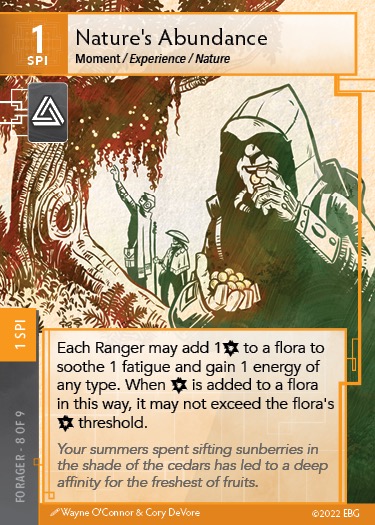
An all-around good card. Soothing fatigue is helpful to rebuild your hand size and get under the injury threshold of certain predators. Adding energy is always welcome.
If you are running the Tea Kit as well, this card can trigger the Response on the Tea Kit. So you are getting two wildcard energy for the price of one.
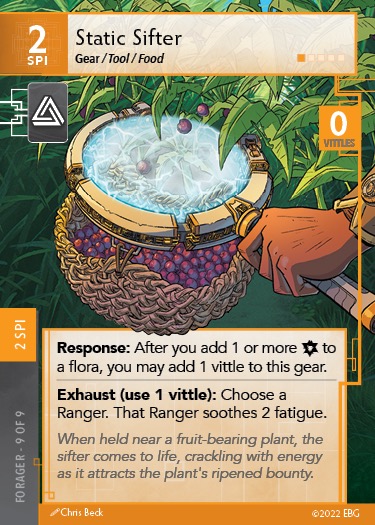
For a Flora engine deck, this is a great way to soothe fatigue. It’s built to be even better in multiplayer but it is still excellent for the solo ranger. The main drawback is that it is a gear card. Although one equip cost is not high in itself, if you take the Tea Kit and the Trowel, now you’ve maxed out your gear. As a 1 equip cost, it also doesn’t benefit from the Pocketed Belt Pouch’s reduction.
All that aside, it will satisfy all your fatigue soothing needs. At the exchange rate of 1 Vittle for 2 Fatigue, you only really need to get 3 or 4, maybe 5, vittles here over the course of day to handle the amount, in my experience, of Fatigue you will take in an average day.
I think you’d be better served to soothe fatigue by grabbing Favorite Gear from Artisan as your Outside Interest and putting it on the Tea Kit.
Aspect Considerations
Of the 2 requirement cards, I would rank the Trowel and the Tea Kit as the most important for the Forager Flora engine. Puffercrawler Spores expands your Flora engine to Beings, but it isn’t essential, and there are other ways to soothe fatigue than use Static Sifter. If you take 2 FIT to take the Trowel, you should take 2+ SPI as well to maximize your ability to add or remove harm from flora.
The most obvious dump stat strictly from a Forager perspective is AWA. You only miss out on Puffercrawler Spores.
Deck Starting Points
- Forager – Explorer : Well-Rounded Naturalist
- Forager – Conciliator : Surly Gardener
- Forager – Artificer : Energizer Bunny
- Forager – Shaper : Pacifist Gardener
Mother of Invention is a great card to grab from an Elder in a Pivotal Location to get more uses out of your Forager Attachment cards.
Conclusion
Forager gives you self-sufficiency through manipulating flora cards to clear features, soothe fatigue, and gain energy.
 Go Wild Board Games
Leave a comment