
Strap on your Hydrolens Goggles and get ready for the closeup look at the Explorer Specialty in Earthborne Rangers. Or don’t, because if you did you would know what I’m going to say and not need to read along!
This is part of my deck construction series in which I work through the starting cards in each Specialty and Background. I don’t discuss Reward cards or get too deep into synergies between Specialties and Backgrounds. I don’t want these to get too complex and lengthy, but at the bottom I do offer some deck combinations for you to look over for ideas and inspiration. I may expand these posts in time to include more discussion of the different possible combinations.
Deck Construction Series
-
Artisan Deck Construction in EBR
-
Shepherd Deck Construction in EBR
-
Forager Deck Construction in EBR
-
Traveler Deck Construction in EBR
-
Explorer Deck Construction in EBR
- What makes an Explorer unique?
- Strengths and Weaknesses
- Roles
- Cards by Sphere
- Aspect Considerations
- Deck Starting Points
- Conclusion
What makes an Explorer unique?
Explorers are unique among the specialties in that they don’t have any card traits associated with them. Shapers have Conduits and Manifestations, Artificers love their Tech, and Conciliators adore their Aid. Perhaps as compensation for getting no toys, Explorers get a lot of versatility and several powerful abilities that can act as wonderful cornerstones for your deck.
Explorers emphasize travel. They know and scout the terrain, then use it to their advantage, whether that means avoiding obstacles, finding secret paths, or shoving a predator down a mountain slope. They can be elusive and perceptive of their environment and use that to their advantage.
The primary Explorer deck archetype that I see is that of a Hermit or a Mountain Man. Someone at home in the woods and content to travel, study, and delve into the mysteries of nature, like John Muir exploring the mountains of California and the glaciers of Alaska.
Strengths and Weaknesses
It is commonly known that Mountain Men you need to have a well-rounded set of survival skills and tricks up your sleeve and the Explorer has just that. 10 of the 12 cards I could argue for including in a deck, which is absolutely not the case in the other Specialties. With so many options you are a bit more free in your deck construction process to think of how you want to approach the game, then find that path within the Explorer Specialty, rather than feel you are pushed in a particular direction.
There is excellent synergy within the Specialty around the Trail card trait and Scouting ability. If you want to feature either in your deck you can also build outward into your Background, Outside Interest, and concepts for Deck Progression to create strength on strength and deck with good internal cohesion.
Explorers also get access right away to one of the best cards in the game: Field Journal.
If you think I’ve been too positive towards the Explorer, there are two notable weaknesses. Most prominently, the Explorer roles are not great. One isn’t very useful for a solo Ranger and the other doesn’t equal the Roles from other Specialties in its power or turn-to-turn usefulness.
Also the Explorer is mainly focused on features and scouting the terrain and might struggle placing progress, harm, or otherwise dealing with Beings. Of course you can bolster your abilities here in your choice of Background. I guess even John Muir, author, explorer, and founder of the Sierra Nevada Club that he was, still had some things to work on.
Roles
The two Explorer roles are Peerless Pathfinder and Undaunted Seeker. Let’s consider the Pathfinder first.
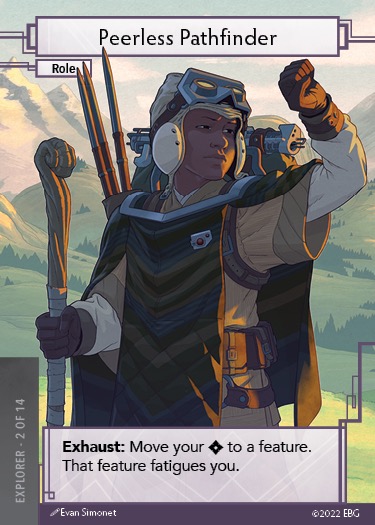
The Pathfinder allows you to place your Ranger token on a feature, then it fatigues you. I’m going to zoom over this one because it doesn’t have as much relevance for the solo Ranger. The main benefit of placing your progress on a feature is that other Rangers get +1 effort when interacting with that feature. No other Rangers, no benefit. Some Features clear through Ranger tokens, so you could testlessly clear a feature, but those features are the clear minority in the game. And if you include Field Journal in your deck you shouldn’t have any trouble performing the innate test on these features to move your Ranger token to it.
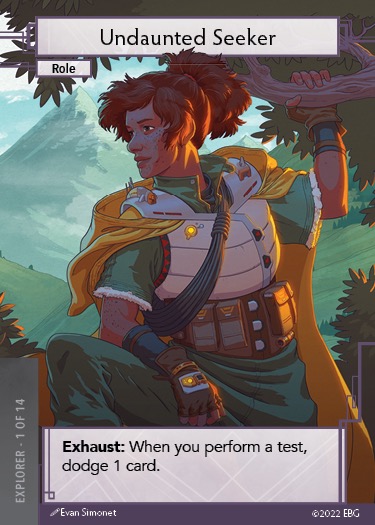
That leaves the other role, the Seeker, for us solo Rangers. Being able to dodge one card once per turn isn’t all that exciting. You will probably use it every turn, but if you didn’t have this Role you could probably just sequence your play a little differently and still succeed at what you set out to do. For example, to Traverse a Feature along the way you could use your role to exhaust a being within reach. If you didn’t have the Seeker role, you could Avoid the Being then Traverse the Feature. That results in you performing more tests, perhaps failing, and drawing more challenge cards. You would end up with a more dynamic environment through challenge effects triggering, but that can work both for or against you. Additionally, if by dodging cards you are less incentivized to clear those cards you may end up with more path cards in play anyway and the same dynamic challenge effect environment.
Cards by Sphere
Awareness
I like the cards in this sphere. They present a theme of being unhindered by path cards, whether in play or the path deck. As such, you can stay focused on your goals at a location and avoid getting bogged down. The danger is that you neglect clearing path cards and create a chaotic and perhaps dangerous morass of challenge effects.
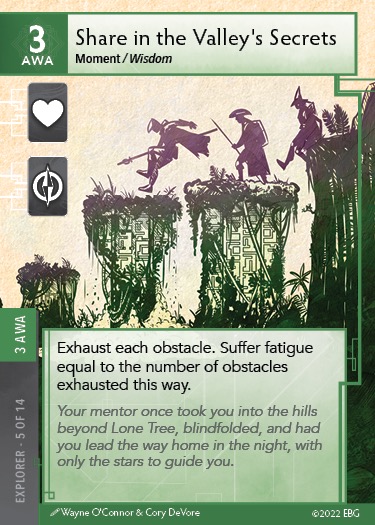
Share in the Valley’s Secrets is a niche card, but a useful one nonetheless. Exhausting an obstacle means you can not only interact past it without taking fatigue, you can also travel if you meet the progress or presence requirements of the location. The fatigue cost is not really a downside once you factor in the time and risk of dealing with those obstacles rather than exhaust them. Obstacles rarely offer a positive potential interaction other than clearing them, so exhausting is just as good as clearing for that one round.
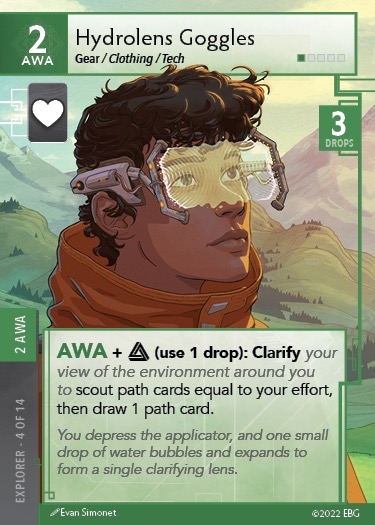
Hydrolens Goggles aren’t as good as Riri the Sparrowhawk, but nothing is quite as good as the companions so don’t hold that against these poor goggles. Scouting the path deck is helpful no matter how you come by it and the Goggles, like Riri, offer you a way to do that with the only upper limit the amount of energy and challenge icons you have available for the test. Pair them with the Phonoscopic Headset for a greater effect!
Even with only 3 charges that should satisfy your scouting needs for a day unless there is some way the Path deck gets reshuffled. The endless scouting potential of Riri is a little overkill in practice.
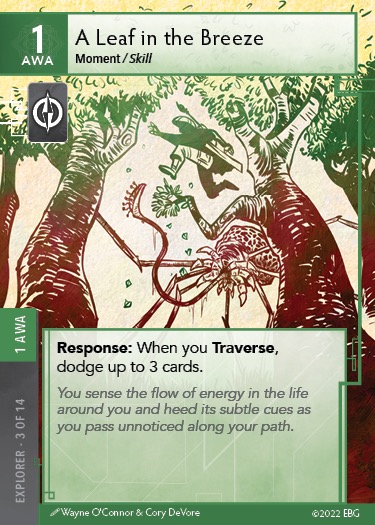
A Leaf in the Breeze is aptly named. With this card you can really Traverse whatever you want. Dodging lets you interact past cards, including obstacles, without taking fatigue. An active obstacle will still prevent you from traveling.
The downside of this card is that it abets any tendency you might have to procrastinate actually dealing with path cards in play by allowing you to ignore them. You may let too many accumulate and get bitten as a result.
Fitness
I don’t particularly like these cards. It feels like Fitness should be an Explorer’s strong sphere but these all feel too niche, too ineffective, and too hefty for what they offer you.
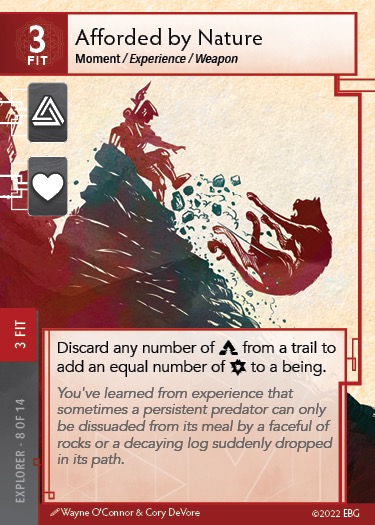
One of two weapons in the Specialty, Afforded by Nature allows you to trade progress on a Trail for harm to a being. The suggestion is to use this in concert with cards that directly build progress on trail as well as your 3 FIT required to take Afforded in the first place.
My main complaint with this card is how much it costs to play. 3 FIT basically nullifies any cost advantage you may have gained by trading progress for harm (progress placed at a 1:1 ratio through Traverse) vs. inflicting harm with a weapon (many are 1 harm for 2 effort).
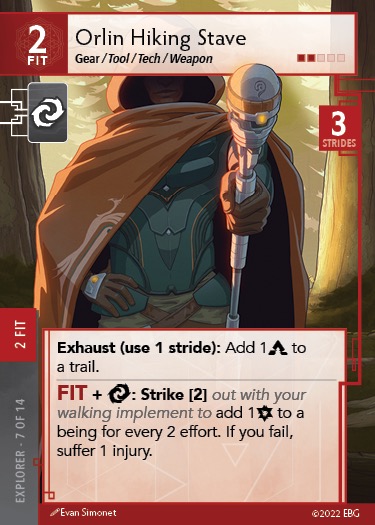
The Orlin Hiking Stave is undermined by the limited utility of its Exhaust ability. Without a way to replenish the Strides on it, you get 3 progress on a trail for the 2 FIT cost to play. You could easily get 3 progress on a trail through a Traverse test with those 2 FIT + some approach icons. Once you use up those Strides the Stave just eats up 2 equip slots for some pretty average harm-dealing abilities. Pass.
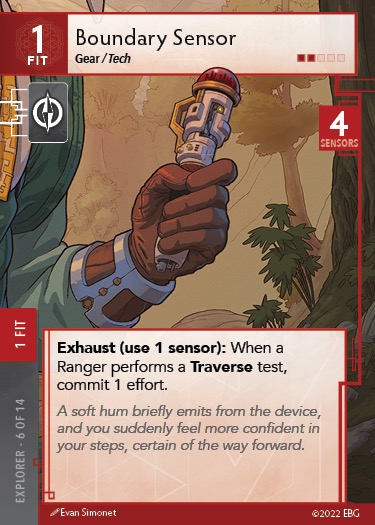
I’m not totally sure why Boundary Sensor takes up 2 gear slots. It looks pretty small. I guess to keep it in line with Ferinodex, which boosts the Avoid test, and the Intention Translator, which boosts the Connect test.
It does offer good return on investment. For the 1 FIT cost you gain 4 total effort for Traverse tests (max 1 per round since you have to exhaust it). So if you don’t mind the gear cost, go for it. But if you have a gear slot hungry deck you should probably pass.
Focus
I love the Focus sphere in Explorer, mainly because Field Journal is such a great card. I’ll rave about it more below, but at every requirement level you gain excellent utility for your investment in FOC energy, which you can’t say for other Specialties.
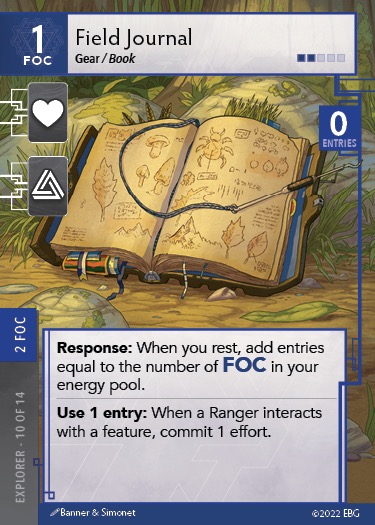
I am taking things a little out of order here and discussing the 2 FOC card before the 3 FOC card, but any discussion about this sphere has to start with Field Journal. It’s that good. Its effect is excellent: a non-exhaust (so use it for as many tests per round as you like) way to boost any test that interacts with a feature. That includes Traversing (supports a 1 FIT build) as well as any tests listed on the feature itself.
The Response takes this to another level because it allows you to do something with – or effectively “spend” – Focus energy every turn, which is otherwise the perpetual dilemma of a high-FOC build. You can transmute that FOC into effort on any test that interacts with a feature. Fantastic!
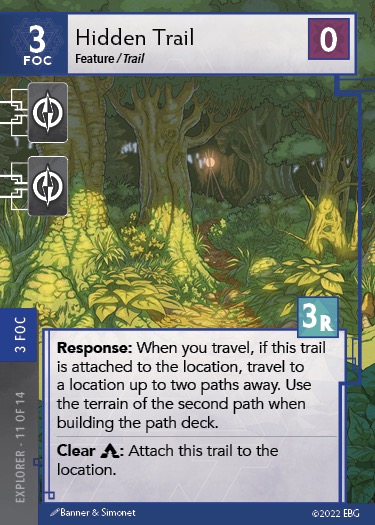
Hidden Trail is decent in itself. Traveling two locations away isn’t that spectactular. There are multiple ways to do that already with certain Valley and Path cards. It does allow a playstyle of fully exploring a location without sacrificing overall mobility around the map. You can use this card to avoid an entire location’s worth of Traversing and dealing with path cards. Seen that way, it’s pretty valuable.
It’s even more valuable when you realize you can run this with Field Journal, so all those rounds you are NOT playing Hidden Trail you are accumulating tokens on Field Journal to use as you wish.
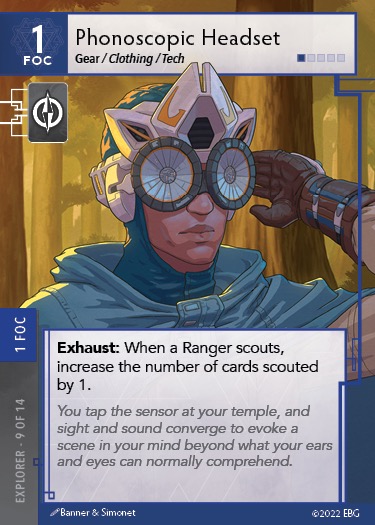
This simple card effect can really enhance the powerful Scouting ability. With no tokens required to Exhaust it, you can use this liberally throughout the day. The obvious pairing is with Hydrolens Goggles. The less obvious pairing is with Novice Lens. Scouting 2 challenge cards per turn…? Sign me right on up for that.
Spirit
Always last because of the layout of RangersDB are the Spirit cards. In this case, the Specialty did not save the best for last. Except for Walk With Me, the cards here won’t be mainstays of your solo deck.
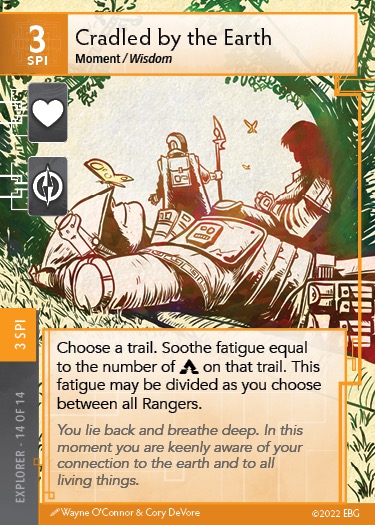
Cradled By the Earth has limited use for the so Ranger because progress on many features scales with the number of Rangers. Do you could see Features with a 9 or even 12 progress threshold. At those higher player counts this card is an incredibly strong group “heal”. For just one Ranger, you would need to play this before you clear a feature which means only 2 or 3 progress and therefore fatigue soothed. That’s just not worth the investment of your high stat requirement card.
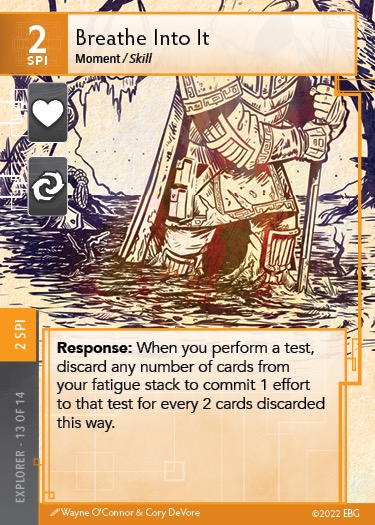
Breathe Into It offers some situational versatility near the end of the day when you have that one final test and want to bring your A game. It sounds sort of interesting as an alternate way to use fatigue, but including this card as part of your plan for your deck is a really bad idea. Why not just plan to soothe that fatigue instead and get vastly more use out of your cards by playing them? Additionally, with the Explorer’s ability to dodge you should be taking less fatigue which runs counter to the way this card is most useful.
Situational at best, mediocre at worst, I’d just skip it altogether.
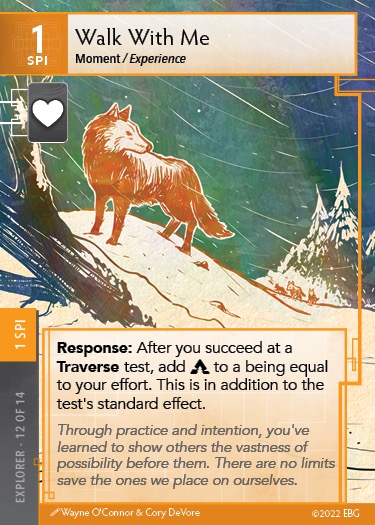
Finally a Spirit card I can gush about! Walk With Me is great, in the footsteps of Follow in Footsteps. It is a must have for a low spirit build and a strong contender for any deck because of the action efficiency.
Aspect Considerations
Unlike the other specialties I can fully endorse any of the 3 Focus Aspects as an Explorer. I also clearly see a rationale for a 1 FIT Explorer. It all hinges on the usefulness of Field Journal, particularly for the solo Ranger, to give you supreme flexibility when you are off on your own exploring the valley.
I think the sweet spot is 2 Focus with AWA or FIT being your high stat, with a slight bias to AWA because its cards are better suited to solo play. I’m not enamored with Afforded by Nature because of how progress scales by number of Rangers and is therefore capped pretty low (only 3 or 4 before a feature would clear) for a solo Ranger.
Spirit cards aren’t great, but a low spirit is almost as hard to play as low fitness. And with the Explorer’s ability to boost tests that interact with features (or dodge/exhaust them) you may be more reliant on the Connect common test to handle beings, unless, that is, your Background fills that need.
Deck Starting Points
- Traveler – Explorer : Level the Field
- Forager – Explorer : Surly Gardener
- Artisan – Explorer : Neutralizer
- Shepherd – Explorer : Ghost in the Valley
Conclusion
Thanks for checking out Conciliator with me. Go kill it with Field Journal and Scout to your heart’s content. If you have any suggestions, questions, or differences of opinion on any cards, drop a comment below. Until next time, happy gaming.
 Go Wild Board Games
Leave a comment