
This is part of my deck construction series in which I work through the starting cards in each Specialty and Background. I don’t discuss Reward cards or get too deep into synergies between Specialties and Backgrounds. I don’t want these to get too complex and lengthy, but at the bottom I do offer some deck combinations for you to look over for ideas and inspiration. I may expand these posts in time to include more discussion of the different possible combinations.
Deck Construction Series
-
Artisan Deck Construction in EBR
-
Shepherd Deck Construction in EBR
-
Forager Deck Construction in EBR
-
Traveler Deck Construction in EBR
-
Explorer Deck Construction in EBR
- What makes a Conciliator unique?
- Strengths and Weaknesses
- Roles
- Cards by Sphere
- Aspect Considerations
- Deck Starting Points
- Conclusion
What makes a Conciliator unique?
At a high level, what do Conciliators do best or what do they do that only they can do? What deck archetypes emerge from within the specialty?
The first and most apparent unique element to Conciliators is Aid cards. Although Aid cards are sprinkled throughout the collection, they definitely have their home here, much like Tech cards are at home in the Artificer Specialty. Tech cards are a useful comparison. Where Tech cards are overwhelmingly Gear, Aid cards are nearly evenly split between Gear and other traits. Then there is the number. There are 22 Tech cards to only 10 Aid cards. Aid cards are therefore a little more niche and the Conciliator cards that replenish Aid card tokens are a little less powerful and useful that cards that key off Tech. Nevertheless, it is a unique aspect of this Specialty.
Less obvious is the Conciliator’s several ways of decreasing or neutralizing the presence of cards in play. Lowering the presence of cards in play has several positive benefits, including fatigue-avoidance and easier tests. Neutralizer is a valid deck archetype for Conciliator play.
The other deck archetype, just to quickly mention, is to make. yourself into an All-Arounder. With good stats and good utility cards you should be able to handle whatever comes out of the deck
Finally, the Conciliators have a number of cards that are either only really useful in group play or see their effects magnified by having other Rangers playing alongside you.
Strengths and Weaknesses
The synergies within the Aid trait, while not as extensive as its cousin the Tech trait, are still very useful and effective. A great example is the Tracked card. You can put this on Pokodo the Ferret and have a little Effort battery to boost up any and all tests you need. Super useful all around card. Or you have more situational cards like Surveyed Land or Tranquilisnare to lower presence on Feature or Beings. Set them, forget them, and interact with them consequence-free.
I also think reducing the presence is a significant strength. These abilities boost what you can accomplish in the path card tableau and the Conciliator gives you multiple ways to achieve that.
However, this is connected to what I feel is a notable challenge of the Specialty to the solo Ranger which is that its cards are more geared towards a Support role. Conciliator lends itself towards a more indirect playstyle like reducing presence of cards, which does allow you maybe to do more on the board, but it doesn’t actually do anything towards clearing that feature or being. You can certainly use your common tests to Traverse or Connect, but you could also end up overwhelmed by too many path cards and not enough ways to clear them.
In a multiplayer setting that isn’t such a problem since you can lean on other Rangers but playing solo you have to do it all. You can make yourself into an All-Arounder and do fine as a Conciliator, but you have to be smart about it and lean on your Common Tests and your Background to get things done.
Another weakness is that the Focus sphere cards are pretty weak, especially for solo play. Safeguard doesn’t make a lot of sense in solo play (possibly not in multiplayer either…) and Nidocyte Sentinel is a pretty weak 3 requirement card. Intention Translator is nice, but you’re probably going to be pretty good at Connect and placing progress on beings anyway with Pokodo so I’m not sure about dedicating 2 gear slots to this card.
Roles
The two Conciliator roles are Voice of the Elders and Guardian. Let’s consider Guardian first.
Guardian allows you to reduce the presence of a being until the end of your turn, although this card has been altered by the errata and I think it is now to the end of the turn, so that other rangers would benefit from the ability too (especially if you use it on a being in their Within Reach area). This role definitely has a little more potential in group play because you will both see more path cards, so likely see a being you want to neutralize, and you can help another Ranger out of a tight spot.
Guardian is little duplicative of the cards in the awareness sphere, Tranquilisnare in particular. The difference is that Tranquilisnare requires additional tokens to achieve what Guardian can do immediately. But Tranquilisnare is a permanent reduction, whereas Guardian needs to be reapplied every turn. Overall, with the strength of Pokodo to place progress on and clear beings, as well as the AWA sphere cards ability to lower presence, I would have liked to see this role take a different direction.
Voice of the Elders is identical in its effect to Exceptional Tinkerer except for Aid cards. It’s not as clearly awesome as the Tinkerer because Aid cards are not as numerous or powerful as Tech cards. Since you might not be including as many Aid cards in your deck and you might have Pokodo as well, Voice of the Elders starts to feel excessive and actually expensive since you need to use an energy to activate it. Finding that energy is probably not too difficult though since it seems like more often than not you will end a turn with at least one energy token unused. In any case, if you only have a couple Aid cards and Pokodo, you may get more use out of the Guardian role.
Cards by Sphere
Awareness
Awareness is a good Conciliator sphere with cards that lower or neutralize the presence of cards in play. A trap of the AWA cards is that through neutralizing presence you may end up with more in play and become vulnerable to challenge effects. At the very least, you will have to account for more potential challenge effect resolutions with more cards in play.
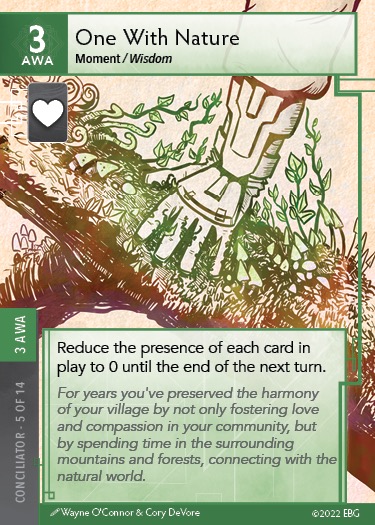
One with Nature is a good, not great, card that seems more powerful than it actually is. It hinges on the word “turn”. A turn is playing a card or performing a test. So one turn is playing One with Nature and just for the next test or card you play, everything has presence 0. It’s helpful if you are facing a cluttered board and need to accomplish one last thing without incurring fatigue. Outside of that hail mary sort of situation it doesn’t help you quite as much.
This is one of the Conciliator cards magnified in multiplayer because it affects all cards in play and “end of the next turn” includes all other Rangers turns.
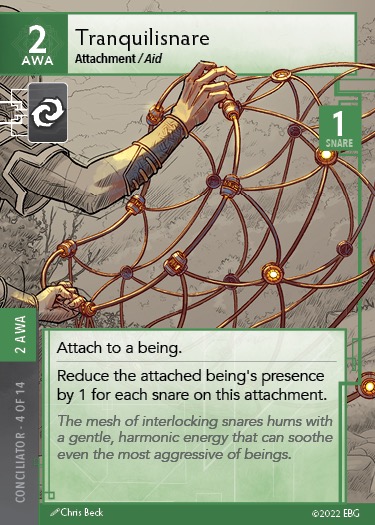
Tranquility Snare is a decent card decent card. You can permanently reduce the presence of a being. This can be really helpful for a big predator or one of the mega-predators on the lure mission. Reducing presence lets you Avoid or Connect more easily, interact beyond without taking fatigue, and some other tests key off Presence. As well, if the predator does damage based on its presence that is reduced as well.
It’s an Aid card so you can quickly boost up the number of snares on it with Pokodo or Voice of the Elders. It does duplicate the effect of Guardian, although Guardian instantly reduces Presence to 0, Guardian has to be reapplied every turn.
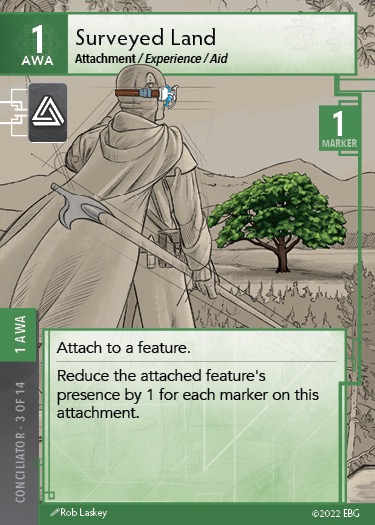
Surveyed Land is the feature version of Tranquilisnare. Lower presence on a Feature makes Traversing it easier, makes you take less to no fatigue for interacting beyond it.
I like Surveyed Land. It’s cheap, it stays around, and helps the lower FIT builds by making Traverse easier.
Fitness
I really like the Fitness sphere cards. Each of them raises the floor of your deck by giving you better all around utility and action efficiency.
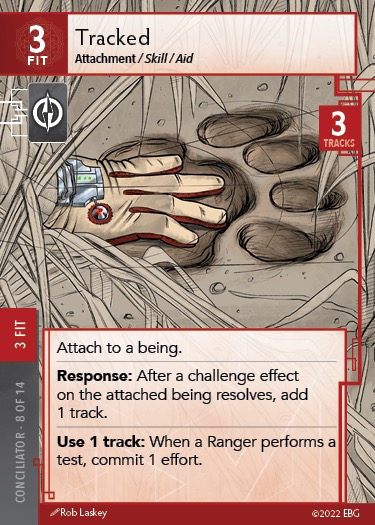
Tracked works well attached to Pokodo in a Conciliator deck. You do miss out on the Response effect, but you also don’t have to worry about discarding it and all its tokens when you travel or the being clears. That said, include two in your deck and put one on Pokodo and one on a being in play you don’t intend to clear. You can always use up a bunch of tokens if you’re about to discard one of the attachments.
I like that it doesn’t require exhausting the card, so you can use it to boost effort on multiple tests in a turn. It really helps you compensate for lower stats or flexibly allocate more effort to whatever test you need to perform at the moment.
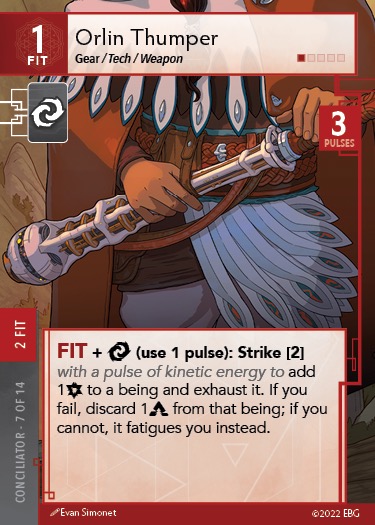
Orlin Thumper is the weapon of the Specialty and it’s not bad. You aren’t going to clear beings through harm with this, but you do get to exhaust it and the penalty for failing is very forgiving.
The limitation of this card is the pulses. It isn’t an Aid card so you don’t have a way of keeping it charged up. You could bring in Universal Power Cell to add 3 tokens to it, but that’s a lot to invest in it. I think it’s better to keep around as a way to stall the bad effects of a predator while you Connect and add progress to it with Pokodo.
And at 1 gear slot it’s not going to weigh you down!
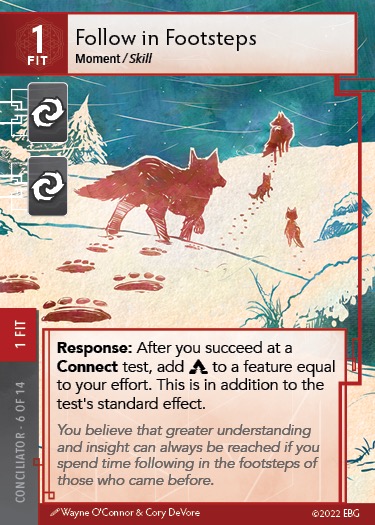
Follow in Footsteps is a great utility card. It supports a 1 FIT build by allowing you to double up the effect of your Connect tests. As a Conciliator you will be Connecting often, at least to Pokodo, and you can make those tests go further with this card.
It combos well with Tracked in that you could add a bunch of effort to Connect to a being then also use that test to clear a feature as well. Two for the price of one, can’t argue with that!
Focus
Focus is the weakest sphere in the Conciliator specialty. Two of the three cards are to niche and situational too justify inclusion in a solo deck. They might have a place in a multiplayer deck because you have more leeway to specialize your build if there are more Rangers.
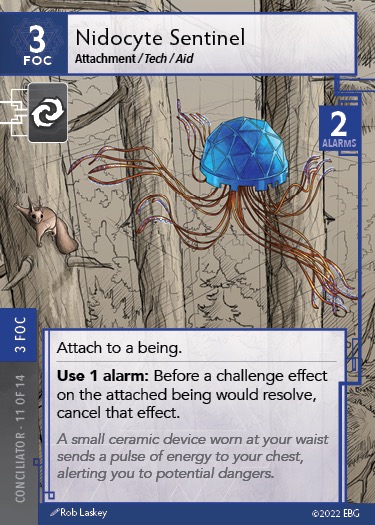
Nidocyte Sentinel is really underwhelming for a solo Ranger. First, the positives. You can cancel any challenge effect, not just an injury (like with Paratrepsis Whistle) and sometimes you want to prevent a predator from activating a non-injury challenge effect. As an Aid card you can also keep it stocked up with tokens pretty easily.
But instead of cancelling a challenge effect, why not build your deck around Avoiding or clearing beings with progress or harm? Those all have the effect of cancelling a challenge effect, but with a greater effect on the game state.
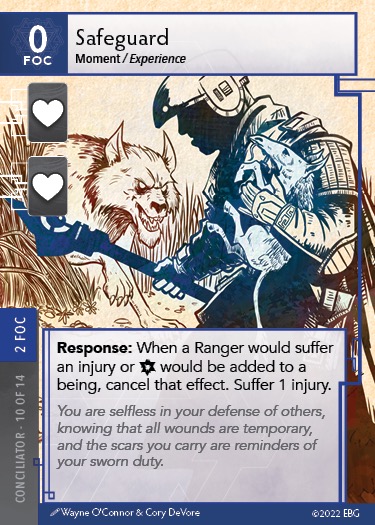
I’ve said enough about this card already and it’s pretty obviously designed for multiplayer. The only possible use as a solo ranger is to protect one of your beings from getting eliminated by a predator but at the pretty high cost of an injury. Probably better to let Pokodo get discarded then play your second copy.
As an aside, I’m not even sure I would want to use this in multiplayer. Tanking an injury for another Ranger seems rarely useful.
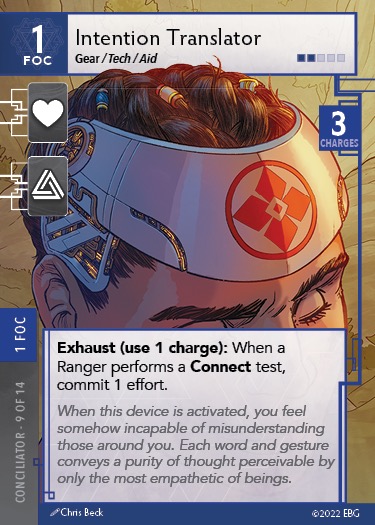
Intention Translator is about the only useful card for a solo Conciliator. It’s an Aid card, so you can get repeated uses out of it and it boosts Connect, which is a test you’ll be performing quite a bit. It isn’t bad in that respect.
But you’d be a fool not to have Pokodo in your deck since it does such a better job of adding progress to Beings. With Pokodo, this gear becomes obsolete and really hard to justify at 2 gear slots.
Intention Translator is probably most useful to non-Conciliator Rangers as either an Outside Interest or mid-campaign swap to boost up a 1 SPI build.
Spirit
Lastly, the Spirit sphere of the specialty has some really nice cards. Every Conciliator should play with Pokodo and Ancestral Teachings is a great dual-purpose card.
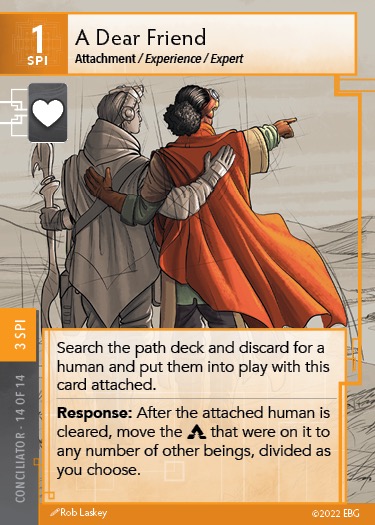
Despite those two, A Dear Friend doesn’t strike me as an amazing 3 req card. It’s nice to be able to go find a human, but it is restricted to Human and not Being. Compared to Seen Through Cycles from the Shaper specialty, A Dear Friend is the worse card.
Recycling the Progress from the human you find is not as great as you might think. You’ll have Pokodo and you’ll have 3 SPI so placing progress on beings is not going to be difficult, even disconnected beings.
There are other, cheaper ways to help yourself scout the path deck. Eagle Eye and Hydrolens Goggles come to mind.
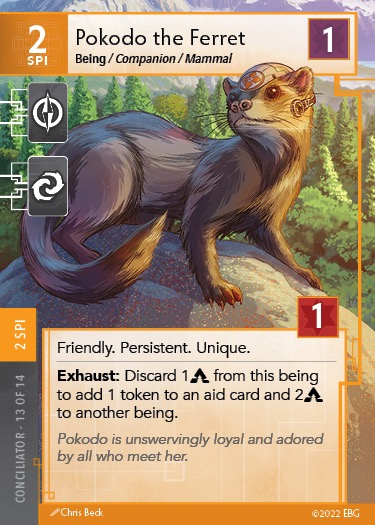
Pokodo the Ferret it is a great card and essential for any Conciliator. First you Connect to Pokodo, who then magnifies that progress to other beings and replenishes/builds up your Aid cards. Early in the day you could connect a couple of times to Pokodo then use that progress for several rounds, meanwhile using your SPI energy for additional tests or card plays.
Like the other Companions Pokodo is a bit overpowered. I wouldn’t be surprised if at some point down the line we see some Errata or a reprint.
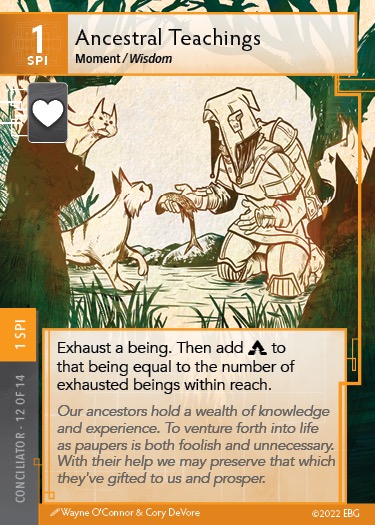
Ancestral Teachings is another also useful 1-cost card. It’s a non-test, non-presence threshold Avoid effect. And it’s cheap. It might be worth inclusion just for this but then you also get to place progress on the Being you just exhausted. If you play with Pokodo and other Companions, or have other exhausted Beings Within Reach, you can add a good chunk of progress with this card.
A particularly useful way to play this card is on a being that is Disconnected, meaning you cannot add progress through a Connect test.
Aspect Considerations
The cards in Conciliator suggest a pretty clear-cut Aspect distribution, at least for solo play: 3 FIT, 2 AWA, 2 SPI, and 1 FOC.
You are going to get so much more mileage out of Tracked than any other 3 req card in the Specialty. If you wanted to get funky and play 3 AWA, you could build your deck around maximizing the use of One With Nature (I try just that in one of the decks below), but it feels like a stretch. A Dear Friend is not useful enough to build your deck around nor is it powerful enough to use in emergencies. In most cases just scouting the path deck is a better all-around option.
FOC is clearly your low stat unless your chosen background has some 2 FOC requirement card you’d really like to include (I try that as well below). If you do go up to 2 FOC, drop your AWA to 1 so you don’t lose out on Pokodo.
Deck Starting Points
- Traveler – Conciliator : Level the Field
- Forager – Conciliator: Surly Gardener
- Artisan – Conciliator : Neutralizer
- Shepherd – Conciliator : Beastmaster
Conclusion
That about covers it for Conciliator! It is not a natural fit for solo play because of many cards are only useful or much better in multiplayer. That said, a 3 FIT/ 2 AWA/ 2 SPI / 1 FOC stat line is a great distribution for a solo Ranger. Great Traverse, Good Avoid and Connect, and, like a lot of solo builds, you may have to prop up your 1 FOC on certain tests through challenge icons (or, in the Conciliator’s case with Tracked).
Thanks for checking out Conciliator with me. If you have any suggestions, questions, or difference of opinion on any cards, drop a comment below. Until next time, happy gaming.
 Go Wild Board Games
Leave a comment